Wednesday, September 10, 2014

Java programming language

. .
Java programming language  
  • Java SE 8.0 - released Mar 2014
  • Just In Time compiler
    • only compiles a section of code when it is needed
    • does not recompile something if already in memory
    • has a warm up cycle so the first time of a compute is a little slower
  • speed
    • 25 times faster than scripting languages like Python, Ruby, Perl, R
    • within 20% of the speed of C, or C++
  • variables have to be declared first
  • Open source - but is controlled by Oracle Corp.
  • easy to distribute
  • runs on all kinds of platforms
  • tons of librarys to ease the coding burden
  • do not have to manage memory (garbage collection)
  • no pointers to complicate issues
  • comparable to C# which is the Microsoft equivalent to Java
  • Java on Wikipedia
  • Java Homepage

Netbeans Integrated Development Environment


  • NetBeans 8.0 IDE - released Mar 2014
  • eases the effort of program development
    • identifies unused variables
    • auto-completion of code
    • set debugging check points
    • output console to read output variables
    • facilitates projects that involve many source files all relating to the samp project
    • automatic compilation of executable .jar files
    • NetBeans on Wikipedia
    • NetBeans Homepage

      Tuesday, September 9, 2014

      air flow in steamlines

      .

      air flowing around objects in streamlines


      streamlined flow is also called laminar flow
      • laminar flow links
      • occurs when a fluid flows in parallel layers, with no disruption between the layers
      • the fluid (air in this case) is comprised of an immense numbers of molecules
      • the molecules are jittering back and forth colliding with themselves at 1100 miles per hour in very short distances (.000001 inches)
      • air velocity (or apparent wind in the case of an iceboat) is less than 10 percent of the molecular speed
      • you must consider the whole streaming flow in a realistic mathematical model of the corresponding lift and drag elements
      • examine the differences between the streamlines in the top diagram where the resistance goes from 100% down to 5%
        • the greater the resistance, the greater the spoiled streamlines at the rear of the wing
        • the roiled air is caused by flow separation of the streamline
        • flow separation happens when the flow streamline exceeds a large curvature within a short distance
      • the more you can reduce of eliminate the eddies (i.e. roiled or turbulent air flow), the better will be the performance

      Sunday, September 7, 2014

      laws of motion

      . 

      Issac Newton discovered the three laws of motion


      • 1st law of motion
        • if the net force (the vector sum of all forces acting on an object) is zero, then the velocity of the object is constant
          • thought experiment A
            • a stationary iceboat is resting on the ice angled at 70 degrees away from true north
            • there is no wind
            • in this situation there are no forces acting on the boat, thus the boat will remain at rest with a constant velocity of zero
          • thought experiment B
            • an iceboat is sailing angled at 70 degrees away from true north
            • wind is blowing at 12 mph from the true north
            • skipper has sheeted to a certain tension on the boom and placed the sheet line in the jam cleat
            • eventually on the 70 degree course the iceboat reaches steady state and is neither speeding up or slowing down
            • the boat is not hiking or side slipping on its runners
          • both experiments A and B are examples of the 1st law of motion
      • 2nd law of motion
        • force = mass * acceleration
      • 3rd law of motion

      Friday, September 5, 2014

      air properties


      physical properties of air


      air molecules

      • nitrogen (N2) - 78.1%
      • oxygen (O2)- 20.9%
      • argon (Ar)- .9%
      • carbon dioxide (CO2)- trace
      • water vapor (H2O) - approx 1%

      air pressure
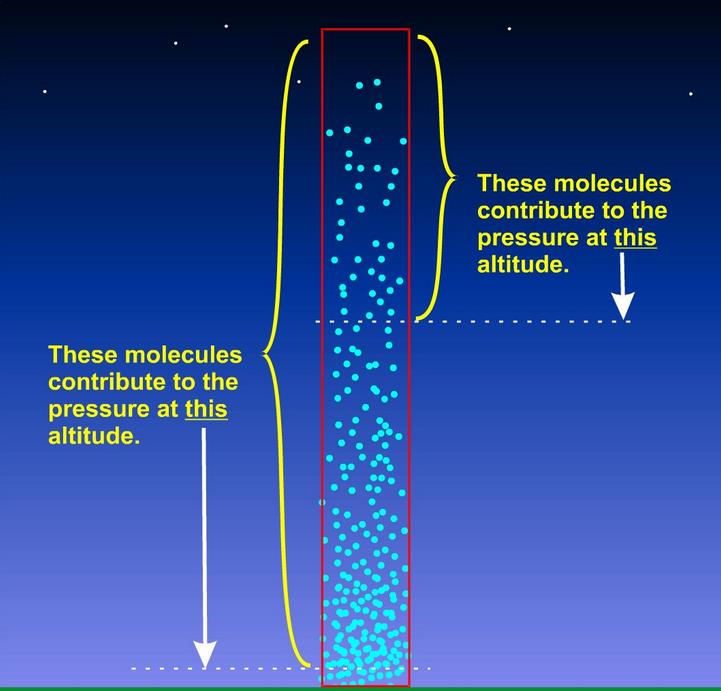
      • force exerted on an object  at a certain elevation by its surrounding air molecules
      • air molecules at a certain level are compressed by the weight of the air molecules above itself
      • air molecules travel at an average speed of 1160 miles per hour
      • this speed directly correlates with the speed of sound
      • 1 cubic foot of air at sea level contains 7.6 x 10**23 molecules


      air pressure by altitude
      • sea level - 14.7 psi
      • 5,000 feet - 12.2 psi
      • 10,000 feet - 10.1 psi
      • 18,000 feet - 7.3 psi
      • Mount Everest - 
      • 50,000 feet - 1.6 psi

      mean free path
      • defined as the average distance any air molecule travels before colliding with another molecule
      • mean free path at sea level = .3 /(10**6) feet
      • this very short distance bounds how air molecules might react with moving objects

      wind
      • movement of air from a high pressure region to a low pressure region
      • at a microscopic level the air molecules are still jittering about as they collide with each other
      • differing pressure regions are primarily caused on earth by:
        • differential heating between the equator and the poles
          • causes air to move from the equator to the pole
        • Coriolis effect of the earth rotating on its axis
          • causes air to move from west to east
        • in northern hemisphere at the 45th parallel, the combination of the above two effects leads to wind on average to blow from the southwest
      • local effects
        • heating and cooling at shorelines of oceans and lakes
        • mountain valleys and large hills
      temperature
      • an increase in air temperature causes an increase in the average air molecule speed
      • as the molecular speed increases, the volume expands in the direction of decreasing pressure which is upwards
      • the expansion causes a corresponding wind vector towards the low pressure area

      Tuesday, September 2, 2014

      Why so fast? detail

      Aerodynamic; low runner friction; minimum drag wing 


      • low runner friction
        • long runner blade
        • extremely smooth and straight runner tip
        • minimum amount of rocker to only enable essential steering
        • runner tip sharpened to match ice and wind conditions
        • must less drag of the iceboat runner over the ice than a typical sailboat would have in sailing in and over the water

      • minimum drag wing
        • sail (ie. wing) is designed to provide maximum driving coefficient: which means the lowest drag possible for the apparent wind angle of the wing
        • low drag is achieved by:
          • small coef. of wing drag
            • camber of sail only matches typical apparent wind angle and no more - much flatter sail than a sailboat
            • rotating mast to align with apparent wind
            • jib or genoa is not used as would cause added drag
          • small induced drag of wing
            • tall rig with short boom
            • boom is very close to deck of fuselage
      • aerodynamic
        • components are streamlined with minimal frontal area
          • slender runner plank
          • tear shaped mast
          • body suits (some classes)
          • oval fully enclosed fuselage (some classes)
      • discussion
        • all of the above combine to produce a boat that travels at 4 to 5 times the speed of the wind
        • such speed multiples means the iceboat operates at apparent wind angles of less than 11 degrees (class dependent)

      Monday, September 1, 2014

      Runner comparison by type

      . 

      activities with runners or other materials sliding on ice/snow
      • iceboat
        • 85 degree to 105 degree face
        • tip stoned to sharp point
        • usually hardened to 47 to 57 Rockwell
        • very low rocker or crown
      • skates
        • hockey skate
        • goalie skate
          • squared off bottom
        • squared off bottom
          • sharp stones edges
        • speed skating
        • figure skating
          • hollow ground
          • large rocker
          • very sharp
      • ice track on closed course downhill 
      • downhill ski
      • cross country ski
      • dog sled
      • radio flier sled
      • horse drawn sleigh
      • curling stone